
WHAT IS POLYMARKET? A PLAIN-ENGLISH EXPLAINER
Polymarket is one of the world's two largest prediction markets — a CFTC-licensed exchange where US traders buy YES/NO contracts on real-world events in US dollars via its app.

Polymarket US · Deposit $10 get a $25 Trading Bonus!
WINClaim21+ · T&Cs apply
18+ Only. Restrictions and eligibility requirements apply. Not available in all jurisdictions. Trading is risky. 100% loss can occur. See polymarket.com/tos for more information. The Polymarket US App serves as an independent software provider and affiliate of Polymarket US and Polymarket Clearing, the CFTC-regulated exchange and clearing organization.

Polymarket US · Deposit $10 get a $25 Trading Bonus!
WIN
18+ Only. Restrictions and eligibility requirements apply. Not available in all jurisdictions. Trading is risky. 100% loss can occur. See polymarket.com/tos for more information. The Polymarket US App serves as an independent software provider and affiliate of Polymarket US and Polymarket Clearing, the CFTC-regulated exchange and clearing organization.
Last checked October 14, 2026
Is Polymarket legal in the United States?
Available to eligible residents (as of October 3, 2026); check current state rules. Polymarket is a CFTC-licensed exchange (through its QCX acquisition) and is legally available to US residents in 49 states plus DC via its app. Nevada is excluded.
TL;DR:
Polymarket is a CFTC-licensed prediction market exchange where users trade YES/NO contracts on real-world outcomes — elections, sports, crypto, culture — traded in US dollars in the Polymarket US app. It's one of the two largest venues in the world by volume, behind Kalshi, and is available to US traders via its app.
Polymarket in one sentence
Polymarket is an online exchange where you buy and sell contracts that pay $1 if an event happens and $0 if it doesn't. The current price is the market's consensus probability — a contract trading at $0.62 means traders collectively price the event at a 62% chance.
It's one of the two largest prediction markets in the world, doing billions in monthly volume. Read our full Polymarket review for the deep dive on fees, app, and bonuses.
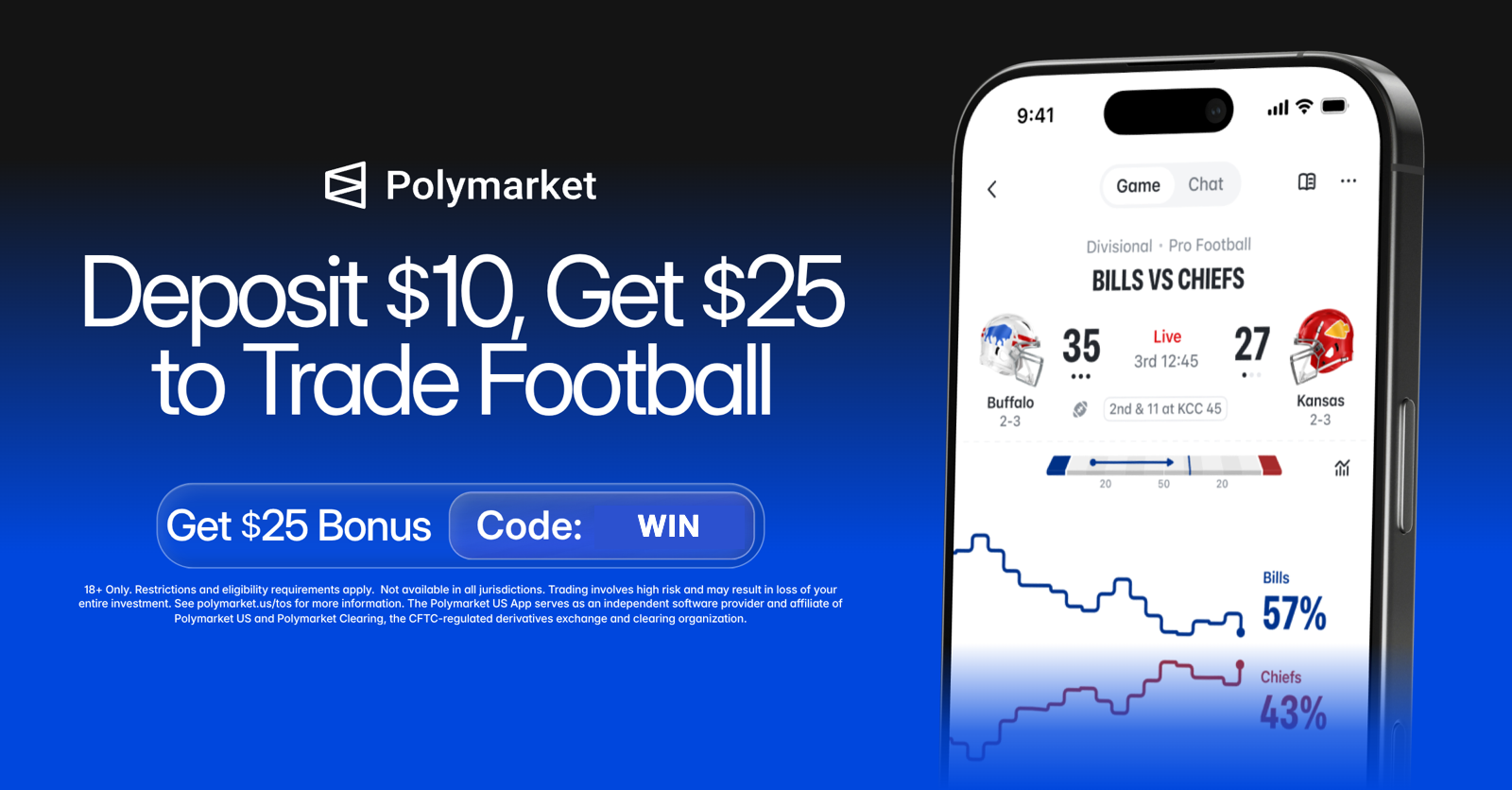
Polymarket: deposit $10, get a $25 trading bonus with code WIN
18+ Only. Restrictions and eligibility requirements apply. Not available in all jurisdictions. Trading is risky. 100% loss can occur. See polymarket.com/tos for more information. The Polymarket US App serves as an independent software provider and affiliate of Polymarket US and Polymarket Clearing, the CFTC-regulated exchange and clearing organization.
Is Polymarket legal in the US?
Available to eligible residents (as of October 3, 2026); check current state rules. Polymarket holds a CFTC Designated Contract Market (DCM) license through its acquisition of QCX and operates legally in 49 US states plus DC. Nevada is the only excluded state.
US users trade in the Polymarket US app, funded and traded in US dollars, with full ID verification. The global web platform serves international users and settles in USDC.
How does Polymarket actually work?
In the US app you fund your account in US dollars. From there, you trade binary YES/NO contracts against other users — there is no house. When the event resolves, winning contracts pay out $1 each, cleared by Polymarket Clearing, the CFTC-regulated clearing organization.
Because Polymarket runs on an order book, prices move continuously based on supply and demand. There's no house taking the other side — you're trading against other users. Check the order screen in the app for what you'll pay before you confirm.
- Sign up via its app (US) or polymarket.com (international)
- Verify your ID and fund in US dollars from the app's deposit screen
- Buy YES or NO at the current price
- Sell anytime before resolution, or hold to $1/$0 settlement
What can you trade on Polymarket?
Politics (US and global elections), crypto prices, Fed and economic data, sports outcomes, awards shows, geopolitical events, weather, even pop-culture markets. New to picking a market? Our how to bet on Polymarket walkthrough covers your first trade.
How does Polymarket compare to Kalshi?
Both are CFTC-licensed and both trade in US dollars for US users. Polymarket is known for deep liquidity on flagship markets; Kalshi leads on traded volume. See our Polymarket vs Kalshi comparison for the full breakdown.
Sources & references
Frequently asked questions
Is Polymarket legal in the United States?
Available to eligible residents (as of October 3, 2026); check current state rules. Polymarket is a CFTC-licensed exchange (through its QCX acquisition) and is legally available to US residents in 49 states plus DC via its app. Nevada is excluded.
What is Polymarket used for?
Trading binary YES/NO contracts on real-world events — elections, sports, crypto prices, economic data, awards, geopolitics, and more. Each contract pays $1 if the event happens, $0 if it doesn't.
How does Polymarket make money?
Like other exchanges, Polymarket US earns from the fees it charges on trading. Check the order screen and fee details in the app for current pricing — we don't quote numbers because they can change.
Do I need crypto to use Polymarket?
No. US users trade in the Polymarket US app, which is funded and traded in US dollars. You don't need crypto or a crypto account.
Is Polymarket safe?
Polymarket US is a CFTC-regulated exchange, trades are cleared by Polymarket Clearing, the CFTC-regulated clearing organization, and every account goes through full ID verification. The main risk is market risk: you can lose 100% of what you put into a position.
21+ · T&Cs apply · Terms
18+ Only. Restrictions and eligibility requirements apply. Not available in all jurisdictions. Trading is risky. 100% loss can occur. See polymarket.com/tos for more information. The Polymarket US App serves as an independent software provider and affiliate of Polymarket US and Polymarket Clearing, the CFTC-regulated exchange and clearing organization.


