
HOW DO PREDICTION MARKETS WORK? A COMPLETE GUIDE
Prediction markets aggregate the wisdom of crowds into probabilities — here's the mechanics, the math, and the evidence they actually work.

Kalshi · Trade $25 and Get $25!
WINPREDICTSClaim21+ · T&Cs apply
Certain limitations apply. The offer is available to new users only, subject to the terms and conditions at kalshi.com/tc/500. 18+ only. Restrictions and eligibility requirements apply. Event contract trading involves significant risk and is not appropriate for everyone. Please carefully consider if it is appropriate for you in light of your personal financial circumstances. Kalshi products are not available in all jurisdictions. See kalshi.com/regulatory for more information.

Kalshi · Trade $25 and Get $25!
WINPREDICTS
Certain limitations apply. The offer is available to new users only, subject to the terms and conditions at kalshi.com/tc/500. 18+ only. Restrictions and eligibility requirements apply. Event contract trading involves significant risk and is not appropriate for everyone. Please carefully consider if it is appropriate for you in light of your personal financial circumstances. Kalshi products are not available in all jurisdictions. See kalshi.com/regulatory for more information.
Last checked October 14, 2026
How do prediction markets work in simple terms?
You buy contracts that pay $1 if an event happens, $0 if it doesn't. The price you pay (between $0.01 and $0.99) is the market's consensus probability. If you think the real probability is higher, you buy YES; if lower, you buy NO.
TL;DR:
Prediction markets are exchanges where users trade contracts that pay $1 if an event happens and $0 if it doesn't. Prices act as crowd-sourced probabilities and routinely beat expert forecasts — a finding documented from the Iowa Electronic Markets through to modern Polymarket and Kalshi data.
The one-sentence definition
A prediction market is an exchange where users trade contracts whose payouts depend on the outcome of a future event. Each binary contract pays exactly $1 if the event happens and $0 if it doesn't — and the current price is the market's consensus probability.
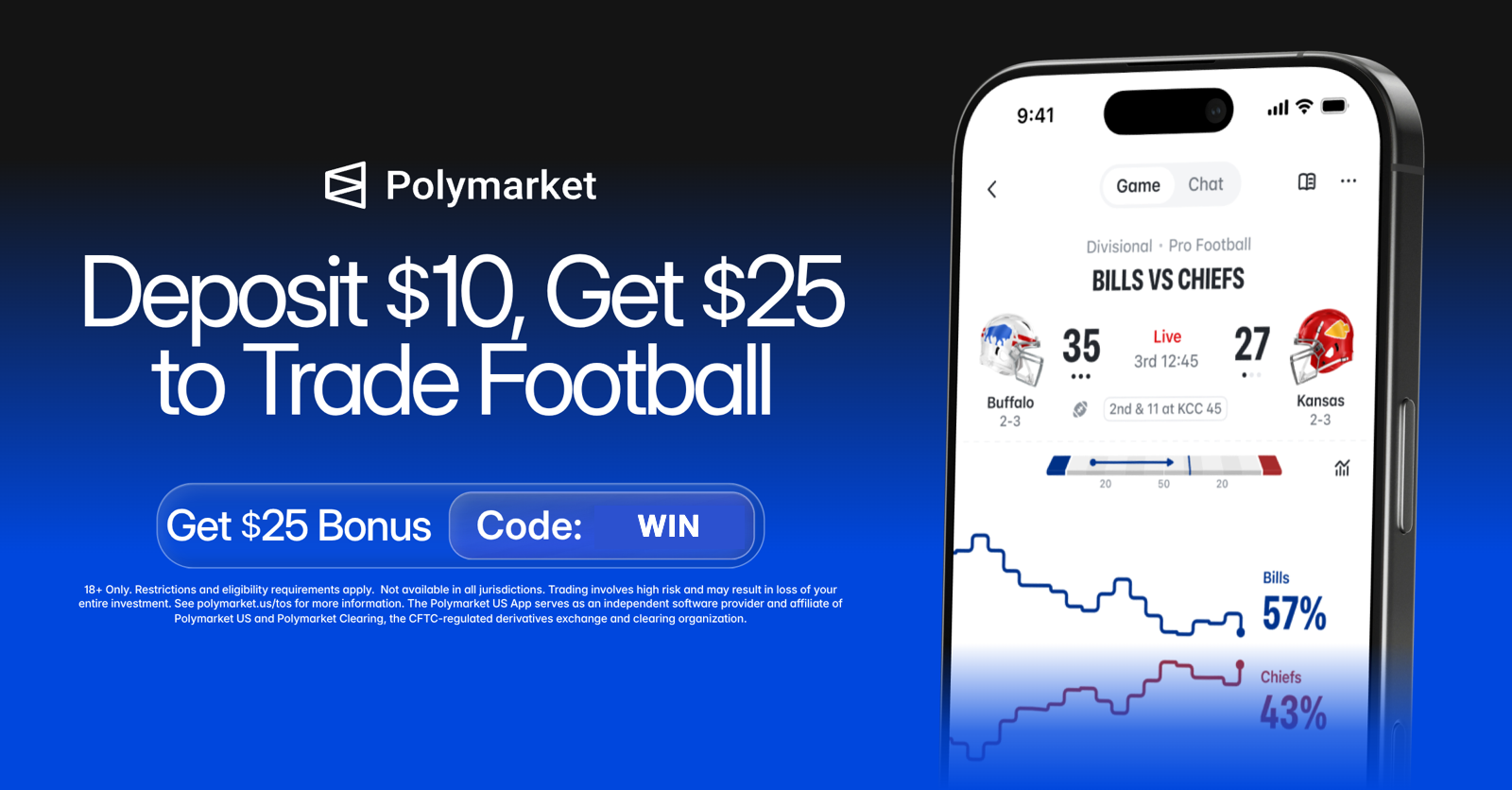
Polymarket: deposit $10, get a $25 trading bonus with code WIN
18+ Only. Restrictions and eligibility requirements apply. Not available in all jurisdictions. Trading is risky. 100% loss can occur. See polymarket.com/tos for more information. The Polymarket US App serves as an independent software provider and affiliate of Polymarket US and Polymarket Clearing, the CFTC-regulated exchange and clearing organization.
Why the price equals the probability
If a contract pays $1 when an event resolves YES and you can buy it for $0.40, you're being offered a 150% return when the event happens. Rational traders will keep buying until the price reflects their best estimate of the probability — which is exactly $0.40 if they think it's a 40% event. With many traders, the equilibrium price converges to the crowd's consensus probability.
Price = probability. That's the entire mental model.
Where the liquidity comes from
Modern venues like Polymarket and Kalshi use a continuous order book — you trade against other users, not against a house. Some markets also use automated market makers (AMMs) to seed liquidity. Either way, there's no traditional bookmaker margin: costs come from the bid/ask spread and each venue's trading fee (Kalshi charges a per-trade fee that scales with contract price).
Do prediction markets actually work?
The empirical evidence is strong. The Iowa Electronic Markets have outperformed major election polls in 74% of presidential races since 1988. Polymarket called the 2024 US presidential winner days before mainstream pollsters converged. Robin Hanson's work on information aggregation formalized why this happens: traders have skin in the game, so they reveal information that pollsters don't capture.
Where you can legally trade prediction markets
Where you can trade prediction markets In the US, the main CFTC-regulated venues are Kalshi, Polymarket US and OG (North American Derivatives Exchange, Inc., doing business as OG.com); which markets you can trade depends on your state. Rebet covers the sweepstakes niche. See our ranked best platforms.
What can go wrong
Markets can be thin, especially on niche events — wide spreads eat the edge. Resolution disputes happen (Polymarket had a notable Russia/Ukraine dispute in 2023). And like any market, prediction markets can be wrong, especially on low-probability tail events where the price is anchored too far from reality.
Sources & references
Frequently asked questions
How do prediction markets work in simple terms?
You buy contracts that pay $1 if an event happens, $0 if it doesn't. The price you pay (between $0.01 and $0.99) is the market's consensus probability. If you think the real probability is higher, you buy YES; if lower, you buy NO.
Are prediction markets accurate?
Yes — repeatedly more accurate than polls and expert panels. The Iowa Electronic Markets beat polls in 74% of presidential races since 1988, and Polymarket called the 2024 election winner before mainstream pollsters converged.
How do prediction markets make money?
Through trading fees rather than a margin in the price — Kalshi charges a per-trade fee that scales with contract price; check the Polymarket US app for its current fee schedule. They don't make money as a bookmaker — there is no house betting against you.
Are prediction markets legal in the US?
Available to eligible residents on CFTC-regulated venues (as of October 3, 2026); check current state rules. Kalshi (CFTC DCM) and Polymarket (CFTC-regulated exchange and clearing organization, via its US app) are both legally available to US residents.
What makes a prediction market different from other ways of wagering?
A prediction market matches users against each other on an exchange. Nobody sets a line and takes the other side, so the price is simply what other traders will pay — your cost is the spread plus a small trading fee.
21+ · T&Cs apply · Terms
Certain limitations apply. The offer is available to new users only, subject to the terms and conditions at kalshi.com/tc/500. 18+ only. Restrictions and eligibility requirements apply. Event contract trading involves significant risk and is not appropriate for everyone. Please carefully consider if it is appropriate for you in light of your personal financial circumstances. Kalshi products are not available in all jurisdictions. See kalshi.com/regulatory for more information.


