
WHAT ARE PREDICTION MARKETS? A COMPLETE BEGINNER'S GUIDE
Prediction markets let you trade on the outcome of real-world events. Here's how they work, why they're surprisingly accurate, and how to start.

Kalshi · Trade $25 and Get $25!
WINPREDICTSClaim21+ · T&Cs apply
Certain limitations apply. The offer is available to new users only, subject to the terms and conditions at kalshi.com/tc/500. 18+ only. Restrictions and eligibility requirements apply. Event contract trading involves significant risk and is not appropriate for everyone. Please carefully consider if it is appropriate for you in light of your personal financial circumstances. Kalshi products are not available in all jurisdictions. See kalshi.com/regulatory for more information.

Kalshi · Trade $25 and Get $25!
WINPREDICTS
Certain limitations apply. The offer is available to new users only, subject to the terms and conditions at kalshi.com/tc/500. 18+ only. Restrictions and eligibility requirements apply. Event contract trading involves significant risk and is not appropriate for everyone. Please carefully consider if it is appropriate for you in light of your personal financial circumstances. Kalshi products are not available in all jurisdictions. See kalshi.com/regulatory for more information.
Last checked October 14, 2026
Are prediction markets legal in the US?
Available to eligible residents (as of October 3, 2026); check current state rules. Kalshi is a CFTC-regulated Designated Contract Market available in 47 states plus DC, and the Polymarket US app is CFTC-regulated and open to US traders in 49 states plus DC (Nevada excluded) as of 2026.
TL;DR:
Prediction markets are exchanges where you trade YES/NO contracts on real-world events — elections, Fed decisions, sports. Prices sit between $0.01 and $0.99 and reflect the crowd's live probability. In 2026, US traders use Kalshi (USD, CFTC) or the Polymarket US app (USD, CFTC-regulated).
One caveat for sports markets in 2026: federal appeals courts are split on whether states can regulate sports event contracts as gambling. The Third Circuit sided with Kalshi against New Jersey on April 6, 2026. The Ninth Circuit (Nevada, August 28, 2026) and the Sixth Circuit (Ohio and Tennessee, September 25, 2026) sided with the states. Kalshi asked the full Sixth Circuit to rehear the case on October 9, 2026; the court has not ruled. The Supreme Court has been asked to resolve the split (see Supreme Court docket 26-299), but hasn't agreed to hear it yet. Non-sports markets aren't the focus of these cases. If you want sports contracts, check the app's eligible-state list, which can change. This is general information, not legal advice. Source: Sixth Circuit opinion.
The basics
A prediction market is a marketplace where participants buy and sell contracts on the outcome of future events — elections, Fed decisions, sports results, even the weather. Each contract pays $1 if the event happens and $0 if it doesn't.
The current price of a contract is the market's consensus probability. If 'Fed cuts rates in June' trades at $0.71, the market is pricing a 71% chance of a cut.
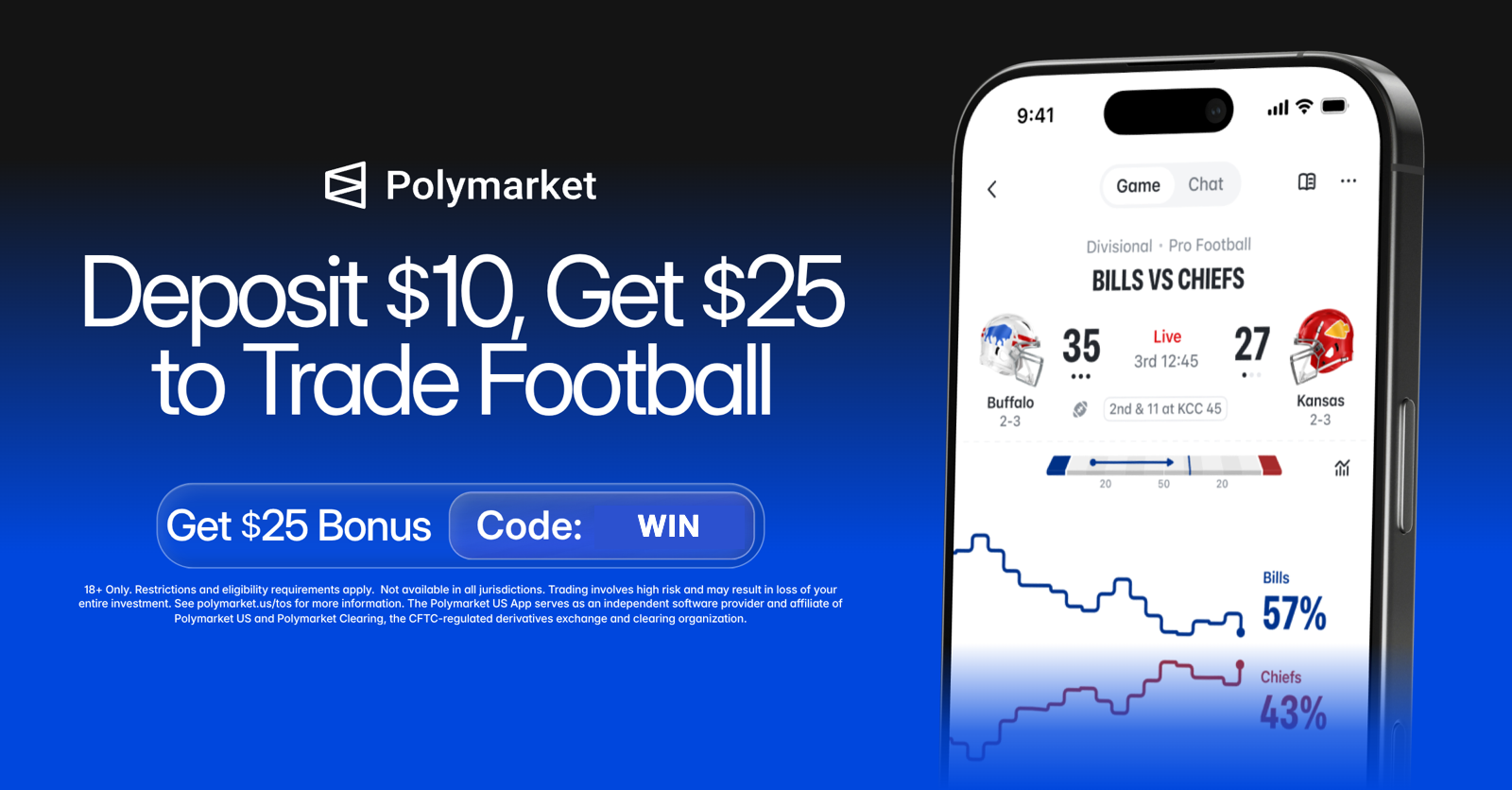
Polymarket: deposit $10, get a $25 trading bonus with code WIN
18+ Only. Restrictions and eligibility requirements apply. Not available in all jurisdictions. Trading is risky. 100% loss can occur. See polymarket.com/tos for more information. The Polymarket US App serves as an independent software provider and affiliate of Polymarket US and Polymarket Clearing, the CFTC-regulated exchange and clearing organization.
Why they're surprisingly accurate
Pollsters and pundits don't lose money when they're wrong. Traders do. That financial incentive concentrates information faster than any single forecaster.
Decades of academic work — from the Iowa Electronic Markets to Robin Hanson's information-aggregation studies — show prediction markets routinely beat expert panels on accuracy.
The price isn't an opinion. It's the forecast.
Where to actually trade
In the US, both Kalshi and Polymarket are CFTC-licensed venues. Kalshi accepts real USD via ACH; the Polymarket US app also funds and trades in US dollars, with full ID verification. (Polymarket's international site, not for US users, uses USDC.)
Mobile-first apps like Rebet offer a social, sports-heavy entry point for US users who want a lighter on-ramp before sizing up.
- Kalshi — US, CFTC-regulated, real dollars
- Polymarket US — CFTC-regulated, US dollars
- Rebet — US, mobile-native, social & sports-first
What to expect on your first trade
Pick a market you actually have a view on. Decide YES or NO. Check the spread and your downside (you can lose the full premium). Start small — $5–$20 — until the mechanics feel natural.
Sources & references
Frequently asked questions
Are prediction markets legal in the US?
Available to eligible residents (as of October 3, 2026); check current state rules. Kalshi is a CFTC-regulated Designated Contract Market available in 47 states plus DC, and the Polymarket US app is CFTC-regulated and open to US traders in 49 states plus DC (Nevada excluded) as of 2026.
How do prediction market prices work?
A YES contract trades between $0.01 and $0.99. The price is the market's implied probability — $0.62 means the crowd thinks the event has a 62% chance of happening. If it does, the contract settles at $1.
Is trading prediction markets the same as gambling?
Legally no — the CFTC regulates them as event contracts, a form of derivative. Economically they share risk with betting, but the pricing mechanism aggregates information rather than paying out a fixed house edge.
How much money do I need to start?
Not much, but check each app for its current minimums. $10–$20 is enough to place several practice trades and learn the mechanics before sizing up; note that Kalshi's new-user offer (trade $25, get $25) asks you to fund and trade $25, and Polymarket's $25 bonus needs a $10 deposit.
Can I lose more than I put in?
No. Prediction market contracts are fully collateralized — your maximum loss on any position is the premium you paid.
Are prediction markets still legal in my state after the 2026 court rulings?
21+ · T&Cs apply · Terms
Certain limitations apply. The offer is available to new users only, subject to the terms and conditions at kalshi.com/tc/500. 18+ only. Restrictions and eligibility requirements apply. Event contract trading involves significant risk and is not appropriate for everyone. Please carefully consider if it is appropriate for you in light of your personal financial circumstances. Kalshi products are not available in all jurisdictions. See kalshi.com/regulatory for more information.


