
KALSHI VS POLYMARKET 2026: WHICH PLATFORM SHOULD YOU USE?
Head-to-head on regulation, fees, liquidity, and usability. Both are CFTC-regulated and dollar-funded; which one wins depends on where you live and which device you use.

Kalshi · Trade $25 and Get $25!
WINPREDICTSClaim21+ · T&Cs apply
Certain limitations apply. The offer is available to new users only, subject to the terms and conditions at kalshi.com/tc/500. 18+ only. Restrictions and eligibility requirements apply. Event contract trading involves significant risk and is not appropriate for everyone. Please carefully consider if it is appropriate for you in light of your personal financial circumstances. Kalshi products are not available in all jurisdictions. See kalshi.com/regulatory for more information.

Kalshi · Trade $25 and Get $25!
WINPREDICTS
Certain limitations apply. The offer is available to new users only, subject to the terms and conditions at kalshi.com/tc/500. 18+ only. Restrictions and eligibility requirements apply. Event contract trading involves significant risk and is not appropriate for everyone. Please carefully consider if it is appropriate for you in light of your personal financial circumstances. Kalshi products are not available in all jurisdictions. See kalshi.com/regulatory for more information.
Last checked October 14, 2026
Is Kalshi or Polymarket better for beginners?
Kalshi — it takes real USD via ACH or debit card and has a polished mobile app. The Polymarket US app is also CFTC-regulated and funded in US dollars.
TL;DR:
Kalshi = real USD, cleanest US-regulated app, a price-based fee on every trade (about $1.75 per 100 contracts at 50¢), offer in 47 states + DC. Polymarket US = CFTC-regulated app funded in US dollars, 49 states + DC (not Nevada); check the app for current fees. The international site, not for US users, uses USDC. New US traders start with Kalshi; traders who want the $25 bonus, or who live in Michigan or Washington, add Polymarket US.
Quick verdict
If you want the simplest US-regulated path and a polished app: Kalshi.
If you want the $25 bonus on a $10 deposit, or live in Michigan or Washington: Polymarket US. Both are CFTC-regulated, funded in US dollars and open to US traders.
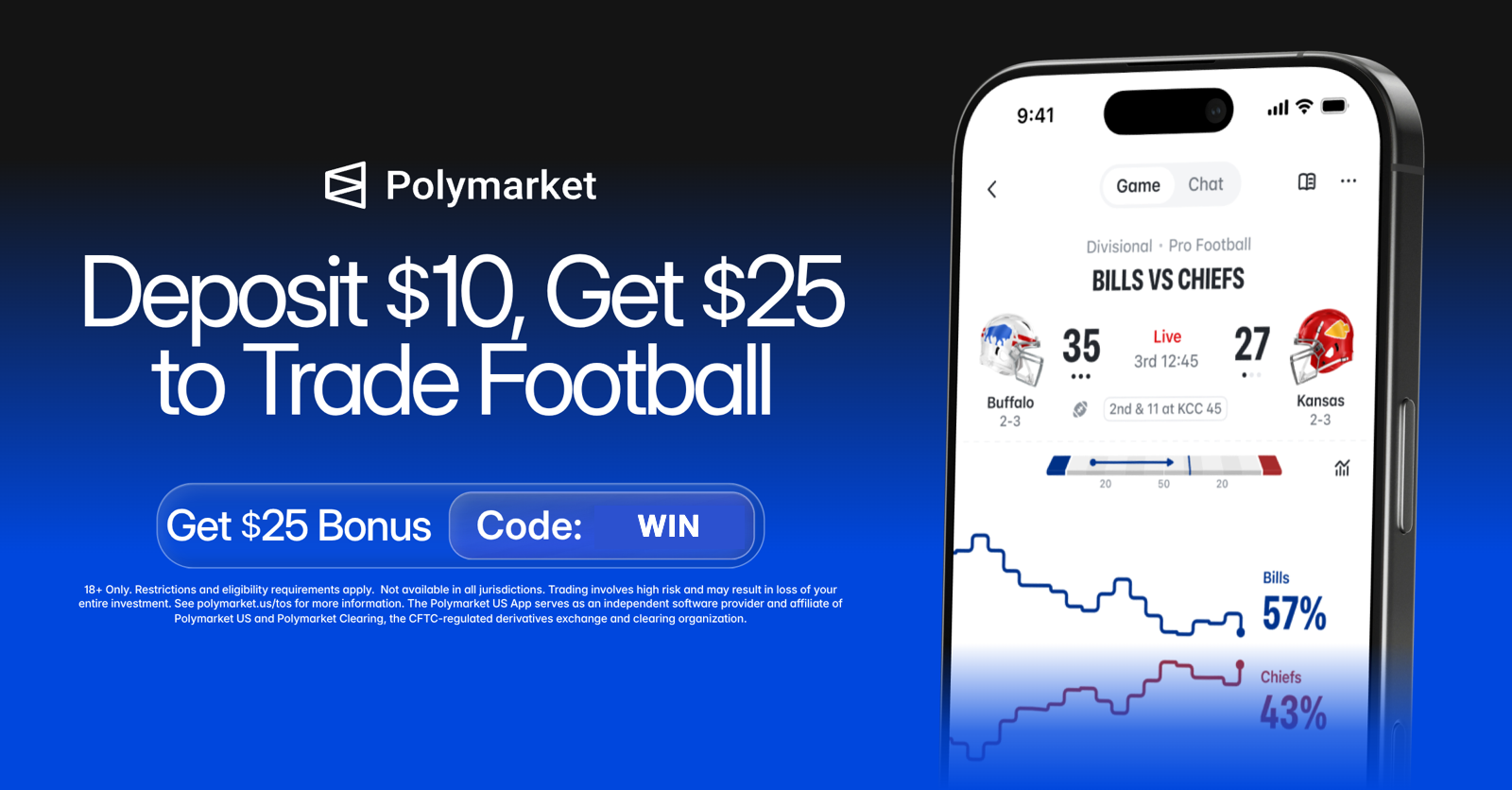
Polymarket: deposit $10, get a $25 trading bonus with code WIN
18+ Only. Restrictions and eligibility requirements apply. Not available in all jurisdictions. Trading is risky. 100% loss can occur. See polymarket.com/tos for more information. The Polymarket US App serves as an independent software provider and affiliate of Polymarket US and Polymarket Clearing, the CFTC-regulated exchange and clearing organization.
Regulation
Kalshi is a Designated Contract Market under the CFTC, supervised like a futures exchange. Polymarket US is also CFTC-regulated: a US exchange with its own clearing organization, funded and traded in US dollars, with full ID verification.
Both are CFTC-regulated, but state rules for sports markets are now in court. Federal appeals courts are split. The Third Circuit sided with Kalshi against New Jersey on April 6, 2026, while the Ninth Circuit (Nevada, August 28, 2026) and the Sixth Circuit (Ohio and Tennessee, September 25, 2026) ruled that those states can likely apply their gambling laws to sports event contracts. Kalshi asked the full Sixth Circuit to rehear the case on October 9, 2026; the court has not ruled. The appeals cases named Kalshi (and, in Nevada, Robinhood and Crypto.com), not Polymarket US. The question, though, is about sports contracts on any CFTC-registered exchange, so the outcome will likely matter to both. The Supreme Court has been asked to settle it (see Supreme Court docket 26-299). Until then, check each app's state list for sports markets. This is general information, not legal advice. Source: Ninth Circuit opinion.
Fees and liquidity
Kalshi charges 0.07 × contracts × price × (1 − price) on each executed trade, rounded up to the next cent, and has solid liquidity. Polymarket US charges orders that fill straight away 0.0695 × contracts × price × (1 − price), and orders that rest on the book pay no fee; liquidity varies market by market, so compare the order book before you trade.
- Kalshi: about $1.75 per 100 contracts at 50¢ · USD deposits · CFTC regulated
- Polymarket US: about $1.74 per 100 contracts at 50¢, resting orders free · USD deposits · CFTC regulated
Usability
Kalshi's mobile app is the cleanest in the industry. Polymarket US asks for full ID verification at sign-up.
Sources & references
Frequently asked questions
Is Kalshi or Polymarket better for beginners?
Kalshi — it takes real USD via ACH or debit card and has a polished mobile app. The Polymarket US app is also CFTC-regulated and funded in US dollars.
Which has lower fees?
They are close. At a 50¢ price, Kalshi charges about $1.75 per 100 contracts and Polymarket US about $1.74 for an order that fills straight away; on Polymarket US an order that rests on the book pays no fee. Both fees are highest near 50¢ and fall toward 1¢ and 99¢.
Which has more liquidity?
It depends on the market. Kalshi is strong on US-specific economic markets like Fed decisions and CPI; the Polymarket US app has its own order book, so compare depth market by market in each app.
Are both legal in the US?
Available to eligible residents (as of October 3, 2026); check current state rules. Kalshi is a CFTC-regulated DCM available in 47 states plus DC (not Michigan, Nevada or Washington); the Polymarket US app is CFTC-regulated and open to US traders in 49 states plus DC (Nevada excluded) as of 2026.
Can I use both?
Yes, and many pros do — Kalshi for USD-native economic markets, Polymarket US for its own market selection and the $25 new-user bonus.
Do the 2026 court rulings affect Kalshi and Polymarket differently?
21+ · T&Cs apply · Terms
Certain limitations apply. The offer is available to new users only, subject to the terms and conditions at kalshi.com/tc/500. 18+ only. Restrictions and eligibility requirements apply. Event contract trading involves significant risk and is not appropriate for everyone. Please carefully consider if it is appropriate for you in light of your personal financial circumstances. Kalshi products are not available in all jurisdictions. See kalshi.com/regulatory for more information.


